Across the globe, the food industry is facing increasing pressure to deliver healthier products without compromising on taste. Consumers are increasingly prioritizing nutrition, gravitating toward cleaner‑label products that maintain strong flavor, remain affordable, and align with evolving trends such as reduced ultra‑processed food intake and GLP‑1‑influenced eating patterns.
At the same time, regulatory pressures are tightening. Policies linked to nutrient profiles, such as HFSS regulations in the UK, and new taxation models like Colombia’s UPF tax, are creating additional urgency for manufacturers to reformulate.
To succeed in this landscape, food producers must strike a careful balance: developing products that meet nutritional expectations while still delivering the bold, memorable flavor consumers demand. Research shows that taste remains the primary driver of purchase across nearly every food category—meaning any move toward healthier products must be matched with uncompromising flavor quality.

A Global Sodium Overconsumption Crisis
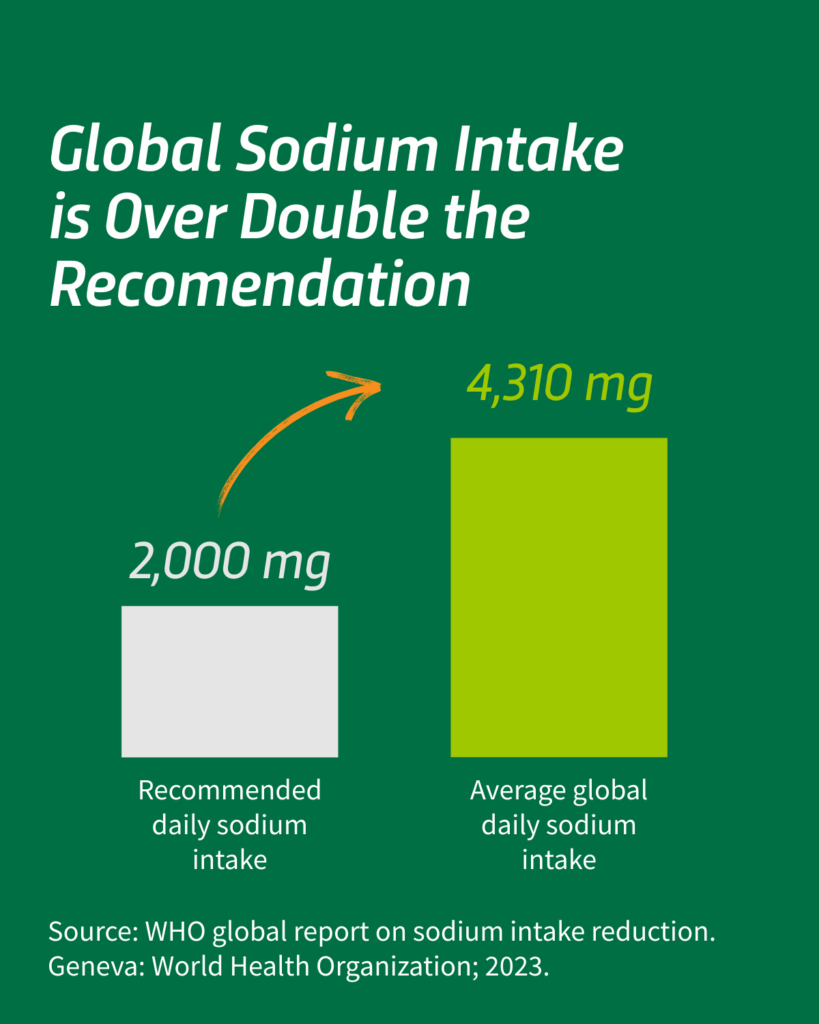
Salt is facing growing scrutiny due to its direct link to negative health outcomes. The World Health Organization recommends that adults consume less than 2000mg of sodium per day (5g salt), yet most people globally consume significantly more than this. In fact, the global average sodium intake is more than double the recommendation at 4310mg of sodium per day, according to a 2023 WHO report (WHO, 2023).
We know that excess salt intake is strongly associated with hypertension, a leading risk factor for cardiovascular disease, and the WHO estimates that this overconsumption of salt leads to millions of cardiovascular-related deaths each year globally. This direct link means that reducing salt intake at the population level can have a large potential impact on public health. For example, a study conducted in China published in 2021 modelled that a sustained 1g salt reduction per person per day could prevent almost 9 million cardiovascular-related deaths by 2030 (Tan et al. 2021). These findings put pressure on the food industry to focus more on reducing salt from products and brings opportunity for purpose driven food businesses to demonstrate the impact they can have on consumer health.
Reformulation Challenges
Reformulating products to reduce salt, or developing lower salt products, is not a simple fix for food producers. Beyond taste delivery, salt brings several other functional aspects to processed foods such as flavor enhancement, preservation enabling longer shelf life, texture development and yield enhancement for processors. This functionality needs to be replaced when reducing salt in order to maintain product quality and consumer expectations of shelf life. But, in the face of consumers looking for recognizable back pf pack ingredients, replacing salt with something ‘chemical sounding’ may not meet the demands of an evolving consumer base, adding an extra challenge.
Creating Lower‑Salt Products That Don’t Compromise on Taste
Salt reduction is not a case of simply removing salt out of formulations, or replacing, but requires a strong cross-functional partnership. At Griffith Foods, we combine our expertise in R&D, food safety and culinary to approach this complex topic.
Regional Director of Culinary at Griffith Foods Europe, Adrian Coulter, recognises this – “Across Quick Service Restaurants, foodservice, and retail outlets, the challenge is to deliver bold, memorable taste while reducing sodium levels. At Griffith Foods, our culinary teams are at the centre of this transformation, partnering with customers to design concepts that remain delicious, appealing, and operationally practical”.
Chef Coulter highlights several key opportunities for culinary-driven solutions in the space:
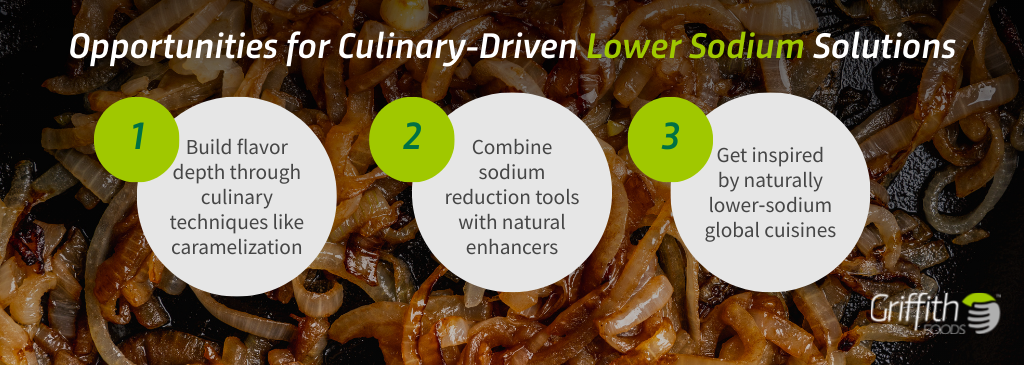
- Build flavor depth through culinary technique: Develop layers of flavor using caramelization, slow‑cooked notes, spices, aromatics, and balanced acidity.
- Combine sodium‑reduction tools with natural enhancers: Leverage our sodium‑replacement technologies alongside natural flavour enhancers to protect both taste and product functionality.
- Get inspired by naturally lower‑sodium global cuisines: Create concepts inspired by flavor‑rich cuisines, such as Mediterranean, Southeast Asian, Mexican, and Modern Indian, that naturally require less added salt.
In recent years, advances have been made in salt replacement technology, with several effective solutions now being commercially available. These replacers still need to be implemented effectively into recipes however to balance salt reduction, cost and flavour delivery. Combining this technical solution expertise with culinary flair will bring many opportunities to develop great-tasting products that can positively impact consumer health.
What’s Next?
The food industry will need to continue to explore salt reduction solutions through new ingredients, technologies and more targeted product design to meet the demands of consumers, regulations and public health strategies. At Griffith Foods, salt reduction in our solutions will continue to be a big focus as we progress towards our 2030 Aspirations focused around creating more nutrient dense and sustainable products. Whilst we recognize the challenge, we are confident that through partnering with suppliers and customers, and leveraging our in house R&D, nutrition and culinary expertise, we can bring successful salt reduced solutions to market that still deliver on taste.
Coulter adds, “At Griffith Foods, we combine culinary creativity with deep technical expertise in collaboration with our R&D teams to help customers lead in both flavour and wellbeing. We don’t see sodium reduction as a compromise for our chefs but rather an opportunity to reimagine taste, explore new culinary territories, and design the future of responsible, delicious food.”
Contact us at Griffith Foods – Contact Us to learn more about how we can support you on your journey of delivering great flavor whilst reducing salt in your products.
References
Tan M, He F, Morris JK, MacGregor G. Reducing daily salt intake in China by 1 g could prevent almost 9 million cardiovascular events by 2030: a modelling study. BMJ Nutr Prev Health. 2022 Aug 16;5(2):164-170. doi: 10.1136/bmjnph-2021-000408. PMID: 36619331; PMCID: PMC9813635.
WHO global report on sodium intake reduction. Geneva: World Health Organization; 2023.